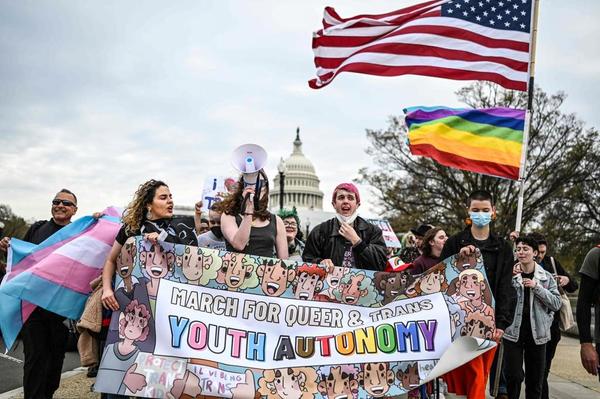
Queer and trans youths lead nationwide marches on Transgender Day of Visibility
LGBTQ youths plan to demonstrate in all 50 states and Washington, D.C., on Friday in what they believe will be one of the largest youth-led protests in history.
The protests and classroom walkouts are part of a coordinated “March for Queer and Trans Youth Autonomy” on Transgender Day of Visibility, which is an annual awareness day dedicated to celebrating the accomplishments of trans people while still acknowledging the violence and discrimination they continue to face.
The events, organized by Queer Youth Assemble, a nonprofit that serves LGBTQ people under 25, are a response to the wave of state legislation introduced by Republican lawmakers over the last three years that seeks to limit what sports teams transgender students can play on at school, restrict minors’ access to transition-related care and prohibit the instruction of LGBTQ-related topics in schools.
The organizers of the events have one central message: Instead of talking about queer youths, talk to them.
“We’re so used to being talked about all the time, but we’re never included in those conversations,” said Alia Cusolito, co-president of Queer Youth Assemble and one of the primary organizers of the march in Washington, D.C., which will start at 3 p.m. ET at Union Station.
“But the real truth is that what we want is to be able to live safely and happily,” they said. “We have no ulterior motives. We just want to be able to live and have everyone be supported and safe in the world.”
So far this year, state lawmakers have filed more than 400 bills targeting LGBTQ people — with more than half of those targeting trans people — according to the American Civil Liberties Union and a separate group of researchers who are tracking the flow of legislation. In the last three years, 19 states have banned transgender students from playing school sports on the teams that align with their gender identity, according to the Movement Advancement Project, and, in the last two years, 11 states have banned transition-related medical care for minors.
The “March for Queer and Trans Youth Autonomy” has a list of demands on its website. Among them, organizers want lawmakers to codify updates to Title IX, the federal law that prohibits sex-based discrimination in publicly funded education programs, so that it specifically protects against discrimination based on sexual orientation and gender identity.
The protests and classroom walkouts are part of a coordinated “March for Queer and Trans Youth Autonomy” on Transgender Day of Visibility, which is an annual awareness day dedicated to celebrating the accomplishments of trans people while still acknowledging the violence and discrimination they continue to face.
The events, organized by Queer Youth Assemble, a nonprofit that serves LGBTQ people under 25, are a response to the wave of state legislation introduced by Republican lawmakers over the last three years that seeks to limit what sports teams transgender students can play on at school, restrict minors’ access to transition-related care and prohibit the instruction of LGBTQ-related topics in schools.
The organizers of the events have one central message: Instead of talking about queer youths, talk to them.
“We’re so used to being talked about all the time, but we’re never included in those conversations,” said Alia Cusolito, co-president of Queer Youth Assemble and one of the primary organizers of the march in Washington, D.C., which will start at 3 p.m. ET at Union Station.
“But the real truth is that what we want is to be able to live safely and happily,” they said. “We have no ulterior motives. We just want to be able to live and have everyone be supported and safe in the world.”
So far this year, state lawmakers have filed more than 400 bills targeting LGBTQ people — with more than half of those targeting trans people — according to the American Civil Liberties Union and a separate group of researchers who are tracking the flow of legislation. In the last three years, 19 states have banned transgender students from playing school sports on the teams that align with their gender identity, according to the Movement Advancement Project, and, in the last two years, 11 states have banned transition-related medical care for minors.
The “March for Queer and Trans Youth Autonomy” has a list of demands on its website. Among them, organizers want lawmakers to codify updates to Title IX, the federal law that prohibits sex-based discrimination in publicly funded education programs, so that it specifically protects against discrimination based on sexual orientation and gender identity.